Prose Assist - find weak points in your writing
But it was a dark and stormy night!
Ishmael recently added a prose assist feature which can highlight potentially weak areas in your writing. Subtle visual hints appear under your text to identify things like broken dialogue punctuation, overuse of adverbs, crutch words, repeated openers, and more. These are the kind of things that tend to be invisible as you write. You may catch them yourself on a second read through (an editor certainly will), but it is always easier to revise a sentence with the plot fresh in your mind.
Ishmael understands 27 writing rules distilled from decades of writing advice from authors and copy editors. These rules are more than mere grammar. For instance, a grammar checker will not complain about the following:
“Well done,” she smiled.
Grammatically correct, but how do you smile words? Ishmael catches slip-ups like that.
Before I go any further, let me address the elephant in the room.
Dear Elephant, this feature is not AI. Ishmael will never write for you. Prose assist will not risk your work being flagged as AI, nor will it exert any pressure to write in a particular way.
Let’s explore a little of what prose assist can do.
Mechanics
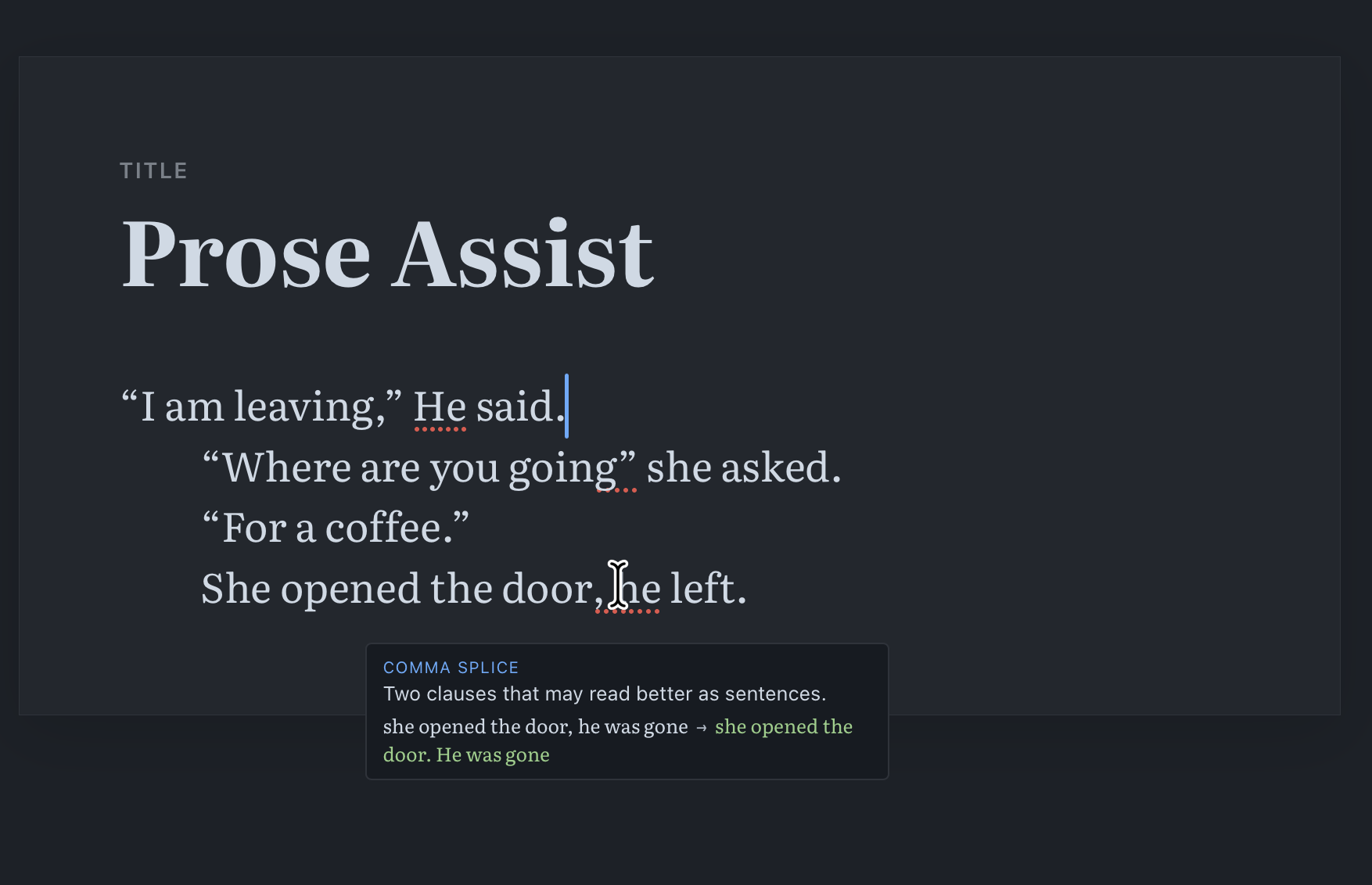
The first class of prose assist rule is mechanics. These are mostly hard rules related to punctuation. They are the kind of errors that come about, not because you don’t know how to punctuate, but as the result of edits—typing too fast, fat fingers, etc. If you don’t see the issue straight away, you can hover the mouse for a helpful tooltip.
Incidentally, a related feature, prose healing, can fix some of these issues on-the-fly.
Habits
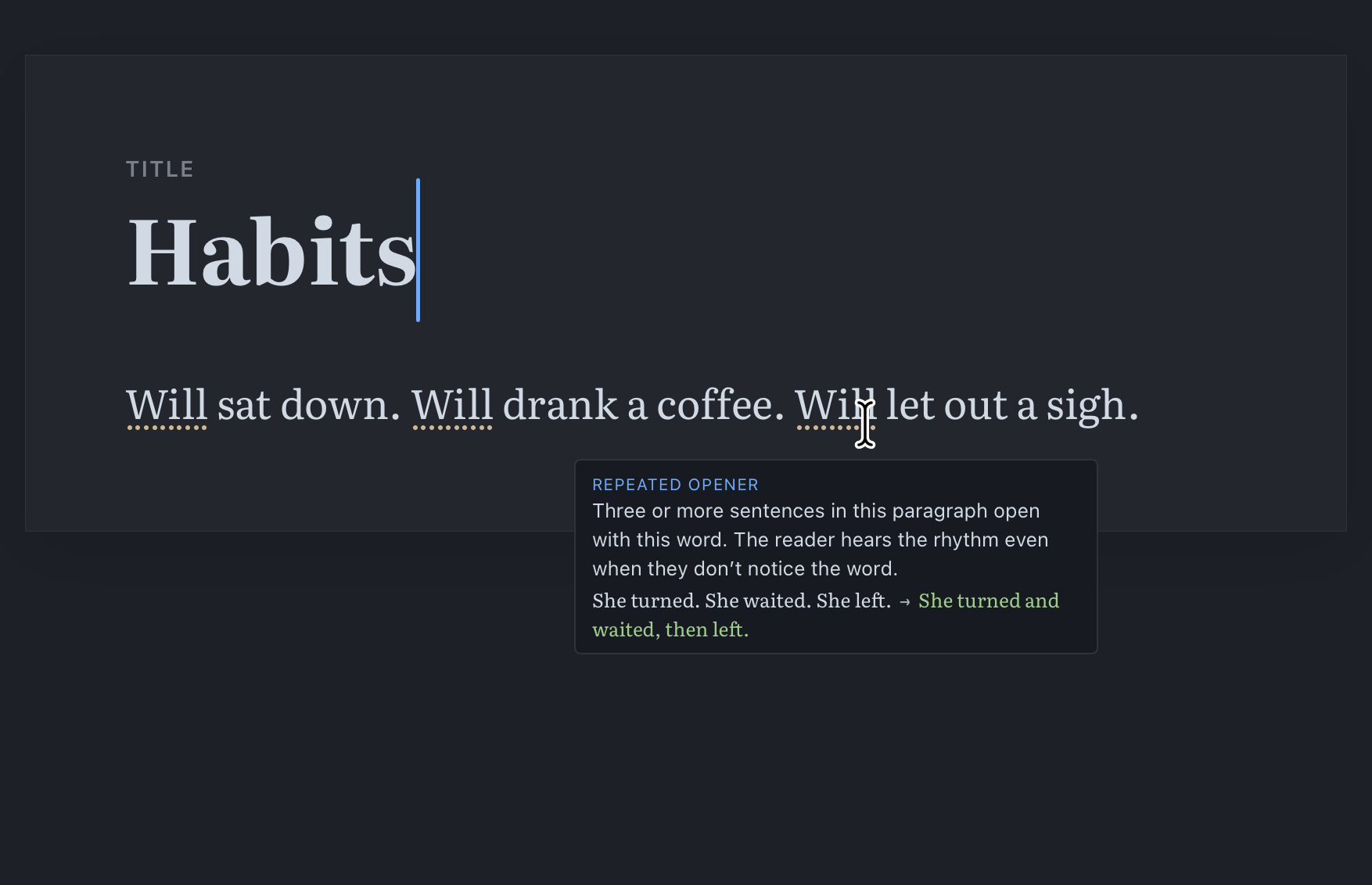
The next category covers the majority of the rules in prose assist and is the most interesting for writers of fiction. These rules identify issues that can result in flat or weak prose—which can be easily fixed. Unlike the Mechanics category, these are more rules of thumb. If Ishmael highlights a habits rule then there is a good chance that it is worth editing your prose in response, but it can occasionally be wrong.
I tested the habits rules on Moby-Dick and some of Herman Melville’s classic novel was highlighted. There are always going to be some false positives. As the writer, your judgement is always required.
Clichés
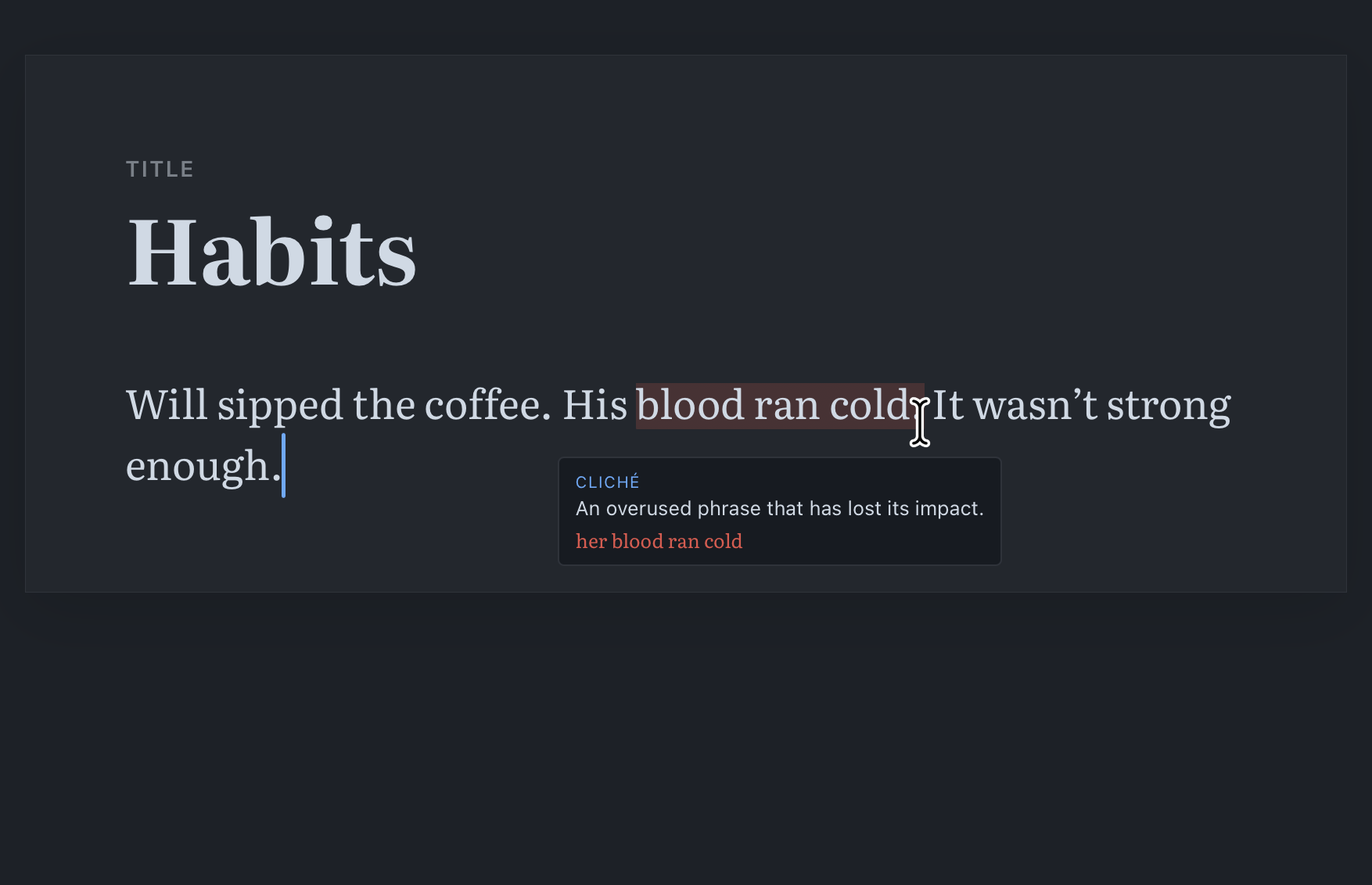
At the time of writing, Ishmael knows of 380 clichés. These are phrases which have entered into the shared consciousness of both readers and writers but are overused to the point they have lost their impact.
Ishmael is smart enough to ignore tense and gender in its clichés, so “his blood ran cold” and “her blood runs cold” will both be flagged.
As always, human judgement is required. Maybe a dark and stormy night really is the best opener.
Paragraph Notes
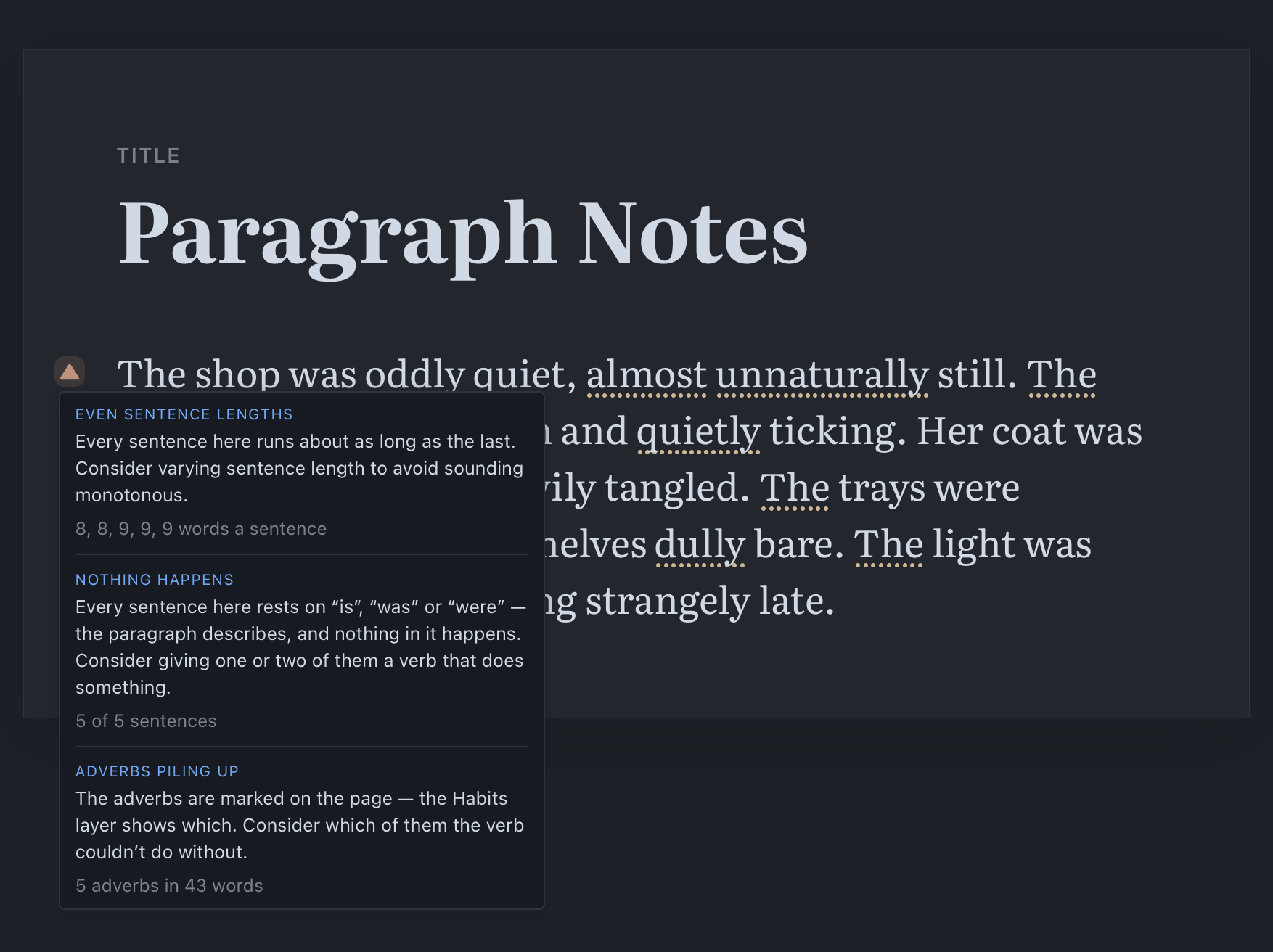
The prose assist features so far have been at the sentence level. Ishmael will also identify weak areas at the paragraph level, such as monotonous sentence lengths, repeated openers, overuse of adverbs and missing dialogue attributions (or action beats).
Summing Up
These features are in some way a response to the AI features that many products are pushing these days. It’s fine to use a computer to make writing easier—I would find writing without a spell checker to be abominable. But your voice should remain yours.